


Cognitive Dissonance Theory 
Cognitive Dissonance theory was first developed by Leon Festinger in 1956 after the publication of a book,  When Prophecy Fails, written with co-authors Henry W. Riecken and Stanley Schachter, to explain how members of a UFO doomsday cult increased their commitment to the cult when a prophesied destruction of the Earth did not happen. The cult's leader, a certain Mrs Keech, had, seemingly, been advised by extra-terrestrials about the Earth's imminent destruction and was also assured by them that the cult, alone, was going to be rescued.
When Prophecy Fails, written with co-authors Henry W. Riecken and Stanley Schachter, to explain how members of a UFO doomsday cult increased their commitment to the cult when a prophesied destruction of the Earth did not happen. The cult's leader, a certain Mrs Keech, had, seemingly, been advised by extra-terrestrials about the Earth's imminent destruction and was also assured by them that the cult, alone, was going to be rescued.In the course of his investigations Festinger, a trained psychologist, actually infiltrated the cult himself and was thus a first hand witness to the groups behavior in the wake of the non-fulfillment of their doomsday prophecy.
Given the reality of Earth's survival the dissonance of the thought between prior belief and failed fulfillment was typically rationalized by the cult members not so much through dismissal of the original prophecy as through modification of that prophecy. That is to say that the cult members tended to accept that the aliens had actually saved the entire world as their route to ensuring the survival of the cult.
Festinger suggested that to rationalize, or change beliefs and attitudes, was an easier route to resolve the stress associated with cogitive dissonance than a complete dismissal of their individual acceptance of the original prophecy.
Festinger, Carlsmith, and several colleagues, went on to more fully and clinically investigate cognitive dissonance theory through an experiment or case study that was developed at Stanford University in 1956 but the results of which became widely known after appearing in an academic psychology journal in 1959:-
We tend to intuitively expect that peoples actions are guided by their opinions but Cognitive Dissonance theory is one of several action-opinion theories which hold that peoples actions can lead to subsequent influence on their individual beliefs and attitudes through rationalisations that takes place to preserve the integrity of that persons self image or overall world view.
Cognitive dissonance theory is based on three fundamental assumptions.
- Humans are sensitive to inconsistencies between actions and beliefs.
- According to the theory, we all recognize, at some level, when we are acting in a way that is inconsistent with our beliefs/attitudes/opinions. In effect, there is a built in alarm that goes off when we notice such an inconsistency, whether we like it or not. For example, if you have a belief that it is wrong to cheat, yet you find yourself cheating on a test, you will notice and be affected by this inconsistency.
- According to the theory, we all recognize, at some level, when we are acting in a way that is inconsistent with our beliefs/attitudes/opinions. In effect, there is a built in alarm that goes off when we notice such an inconsistency, whether we like it or not. For example, if you have a belief that it is wrong to cheat, yet you find yourself cheating on a test, you will notice and be affected by this inconsistency.
- Recognition of this inconsistency will cause dissonance, and will motivate an individual to resolve the dissonance.
- Once you recognize that you have violated one of your principles, according to this theory, you won’t just say "oh well". You will feel some sort of mental anguish about this. The degree of dissonance, of course, will vary with the importance of your belief/attitude/principle and with the degree of inconsistency between your behavior and this belief. In any case, according to the theory, the greater the dissonance the more you will be motivated to resolve it.
- Once you recognize that you have violated one of your principles, according to this theory, you won’t just say "oh well". You will feel some sort of mental anguish about this. The degree of dissonance, of course, will vary with the importance of your belief/attitude/principle and with the degree of inconsistency between your behavior and this belief. In any case, according to the theory, the greater the dissonance the more you will be motivated to resolve it.
- Dissonance will be resolved in one of three basic ways:
- Change beliefs
- Perhaps the simplest way to resolve dissonance between actions and beliefs is simply to change your beliefs. You could, of course, just decide that cheating is o.k. This would take care of any dissonance. However, if the belief is fundamental and important to you such a course of action is unlikely. Moreover, our basic beliefs and attitudes are pretty stable, and people don’t just go around changing basic beliefs/attitudes/opinions all the time, since we rely a lot on our world view in predicting events and organizing our thoughts. Therefore, though this is the simplest option for resolving dissonance it’s probably not the most common.
- Perhaps the simplest way to resolve dissonance between actions and beliefs is simply to change your beliefs. You could, of course, just decide that cheating is o.k. This would take care of any dissonance. However, if the belief is fundamental and important to you such a course of action is unlikely. Moreover, our basic beliefs and attitudes are pretty stable, and people don’t just go around changing basic beliefs/attitudes/opinions all the time, since we rely a lot on our world view in predicting events and organizing our thoughts. Therefore, though this is the simplest option for resolving dissonance it’s probably not the most common.
- Change actions
- A second option would be to make sure that you never do this action again. Lord knows that guilt and anxiety can be motivators for changing behavior. So, you may say to yourself that you will never cheat on a test again, and this may aid in resolving the dissonance. However, aversive conditioning (i.e., guilt/anxiety) can often be a pretty poor way of learning, especially if you can train yourself not to feel these things. Plus, you may really benefit in some way from the action that’s inconsistent with your beliefs. So, the trick would be to get rid of this feeling without changing your beliefs or your actions, and this leads us to the third, and probably most common, method of resolution.
- A second option would be to make sure that you never do this action again. Lord knows that guilt and anxiety can be motivators for changing behavior. So, you may say to yourself that you will never cheat on a test again, and this may aid in resolving the dissonance. However, aversive conditioning (i.e., guilt/anxiety) can often be a pretty poor way of learning, especially if you can train yourself not to feel these things. Plus, you may really benefit in some way from the action that’s inconsistent with your beliefs. So, the trick would be to get rid of this feeling without changing your beliefs or your actions, and this leads us to the third, and probably most common, method of resolution.
- Change perception of action
- A third and more complex method of resolution is to change the way you view/remember/perceive your action. In more colloquial terms, you would "rationalize" your actions. For example, you might decide that the test you cheated on was for a dumb class that you didn’t need anyway. Or you may say to yourself that everyone cheats so why not you? In other words, you think about your action in a different manner or context so that it no longer appears to be inconsistent with your beliefs. If you reflect on this series of mental gymnastics for a moment you will probably recognize why cognitive dissonance has come to be so popular. If you’re like me, you notice such post-hoc reconceptualiztions (rationalizations) of behavior on the part of others all the time, though it’s not so common to see it in one’s self.
- A third and more complex method of resolution is to change the way you view/remember/perceive your action. In more colloquial terms, you would "rationalize" your actions. For example, you might decide that the test you cheated on was for a dumb class that you didn’t need anyway. Or you may say to yourself that everyone cheats so why not you? In other words, you think about your action in a different manner or context so that it no longer appears to be inconsistent with your beliefs. If you reflect on this series of mental gymnastics for a moment you will probably recognize why cognitive dissonance has come to be so popular. If you’re like me, you notice such post-hoc reconceptualiztions (rationalizations) of behavior on the part of others all the time, though it’s not so common to see it in one’s self.
- Change beliefs
Festinger, L. (1957). A theory of cognitive dissonance. Stanford, CA: Stanford University Press.
Festinger, L. and Carlsmith, J. M. (1959). "Cognitive consequences of forced compliance". Journal of Abnormal and Social Psychology, 58, 203-211.
Festinger, L., Riecken, H. W., & Schachter, S. (1956). When prophecy fails. Minneapolis: University of Minnesota Press.
x 

- Festinger, L. (1957). A theory of cognitive dissonance. Stanford, CA: Stanford University Press.
- Festinger, L. (1956). When Prophecy Fails: A Social and Psychological Study of A Modern Group that Predicted the Destruction of the World, by Leon Festinger, Henry Riecken, and Stanley Schachter. Harper-Torchbooks, Jan. 1956.
![[ISBN-0061311324]](http://images.amazon.com/images/P/0061311324.01.MZZZZZZZ.gif "Amazon:ISBN-0061311324")
-

[JPG image (43.06 KB)]
A headline, "prophecy from planet Clarion call to city: flee that flood" in a local newspaper, sating there is a book written by Marian Keech in Michigan state arguing that the world will end in a great flood dawn on December 21, 1954. She and her believer started to prepare for the end of the world - later the cult became scientology. They had left jobs, college, and spouses, and had given away money and possessions to prepare for their departure on the flying saucer, which was to rescue the group of true believers.
-
Festinger and his colleague found that people didn't change their attitudes toward the beliefs even after the prophecy failed. . . .
Make people quit smoking? (public health campaign)
How would you design the message (information) to persuade to quit smoking?
-- By addressing mortality problem, health problem, social stigma associated with smoking in order to change the person's behavior.
-- Will they stop?
-- If yes, people would not have started smoking in the first place . . . .
-- By addressing mortality problem, health problem, social stigma associated with smoking in order to change the person's behavior.
-- Will they stop?
-- If yes, people would not have started smoking in the first place . . . .
Cognitive Dissonance 
Boring experiment
This is the feeling people have when they "find themselves doing things that don't fit with what they know, or having opinions that do not fit with other opinions they hold" (Festinger, 1957, p.4).
Students were asked to spend an hour on boring and tedious tasks. The tasks were designed to generate a strong, negative attitude. After the experiment, the experimenters asked some of them to do a simple favor. They were asked to talk to another subject (actually an actor) and persuade them that the tasks were interesting and engaging. Some participants were paid $20 (inflation adjusted to 2009, this equates to $148.40) for this favor, another group was paid $1 (or $7.42 in "2009 dollars"), and a control group was not asked to perform the favor.
Those who got paid one dollar showed more positive attitudes toward the experiment -- It was interesting. . . .!
TheoryThose who got paid one dollar showed more positive attitudes toward the experiment -- It was interesting. . . .!
This is the feeling people have when they "find themselves doing things that don't fit with what they know, or having opinions that do not fit with other opinions they hold" (Festinger, 1957, p.4).
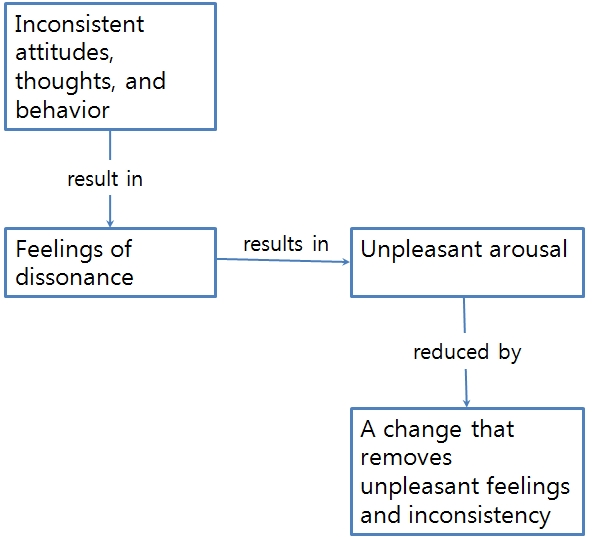
Process of Cognitive Dissonance [JPG image (78.21 KB)]
A state of dissonance = A state of disequilibrium
A state of consonance = A state of equilibrium
A state of consonance = A state of equilibrium
A new things (that are experienced by, input into an individual) may have three different relationship with the ones already in one's one:
- Consonant relationship :
Health and fitness are important vs. A behavior having work-outs five times a week
- Dissonant relationship :
No abortion in Catholic practice" vs. "Woman's right to have abortion
- Irrelevant relationship :
There should be no speed limit on the highway. vs. Fat people should not be discriminated.
Discomfort caused by dissonance motivates (opinion, behavior) change.
-> This is the point where persuasive communication occur.
-> Persuader focuses on inconsistency while providing new behavior that allow for consistency or balance.
-> This is the point where persuasive communication occur.
-> Persuader focuses on inconsistency while providing new behavior that allow for consistency or balance.
Belief
It is important to give back to the community.
I have been blessed with good fortune.
People who have good fortune should share it with other.
The only way the community will prosper is if we all do our share.
Attitude
I like to volunteer my time for the good of others.
Behavior
I tutor at the Literacy center twice a month.
Assumptions 
- Human beings desire consistency in their beliefs, attitudes, and behaviors.
CDT suggests that human being has a such nature to make things consistent (in their mind). (Attribute based perspective)
- Dissonance is created by psychological inconsistencies.
Inconsistency should occur in one psychological state (rather than logical state)
- Dissonance is an aversive state that drives people to action with measurable effects.
People do not enjoy dissonance state; it is an uncomfortable state.
- Dissonance motivates efforts to achieve consonance and efforts toward dissonance reduction.
People do something in order to achieve consonant state.
Concepts 
Magnitude of dissonance
There are degrees of discomfort -- not all dissonance is created equally.
This magnitude are affected by three factors:
This magnitude are affected by three factors:
- Perceived importance : refers to how significant the issue is.
- Dissonance ratio : the amount of consonant cognitions relative to the dissonant ones. The proportion of incongruent idea.
- Ability to justify (rationalize) : If you have more ability to justify the in-congruency, you will get less discomfort.
- Perception :
- Selective exposure
- Selective attention
- Selective interpretation
- Selective hold of information
- Selective exposure
Persuasion 
Postdecision theory??? The state of consonance and dissonance arises after one's decision (of behavior).
Buyer's remorse:
Buyer's remorse:
- After spending more than you feel okay with on a new home, car, vacation, on a woman or some other luxury item, you have to rationalize your spending.
- Sellers and real estate agents make phone calls (and do other things) to convince (or provide) the buyers to think that the decision was excellent. Realtors encourage buyers to make a pro and con list -- then, lead them to put something like gourmet kitchen, Jacuzzi tub, breathtaking views, etc. This lead is an effort to let buyers reduce any dissonance that may occur.
- Advertising companies
- Diet industry make people think un-satisfied appearance or body images. People know that regular exercise would do body good. But, most of us don't exercise. We reduce the dis-comfort by purchasing diet products such as diet-coke.
- If you create too much dissonance, the buyers (people) may decide to avoid the information or even dislike you, instead of changing their behavior.


